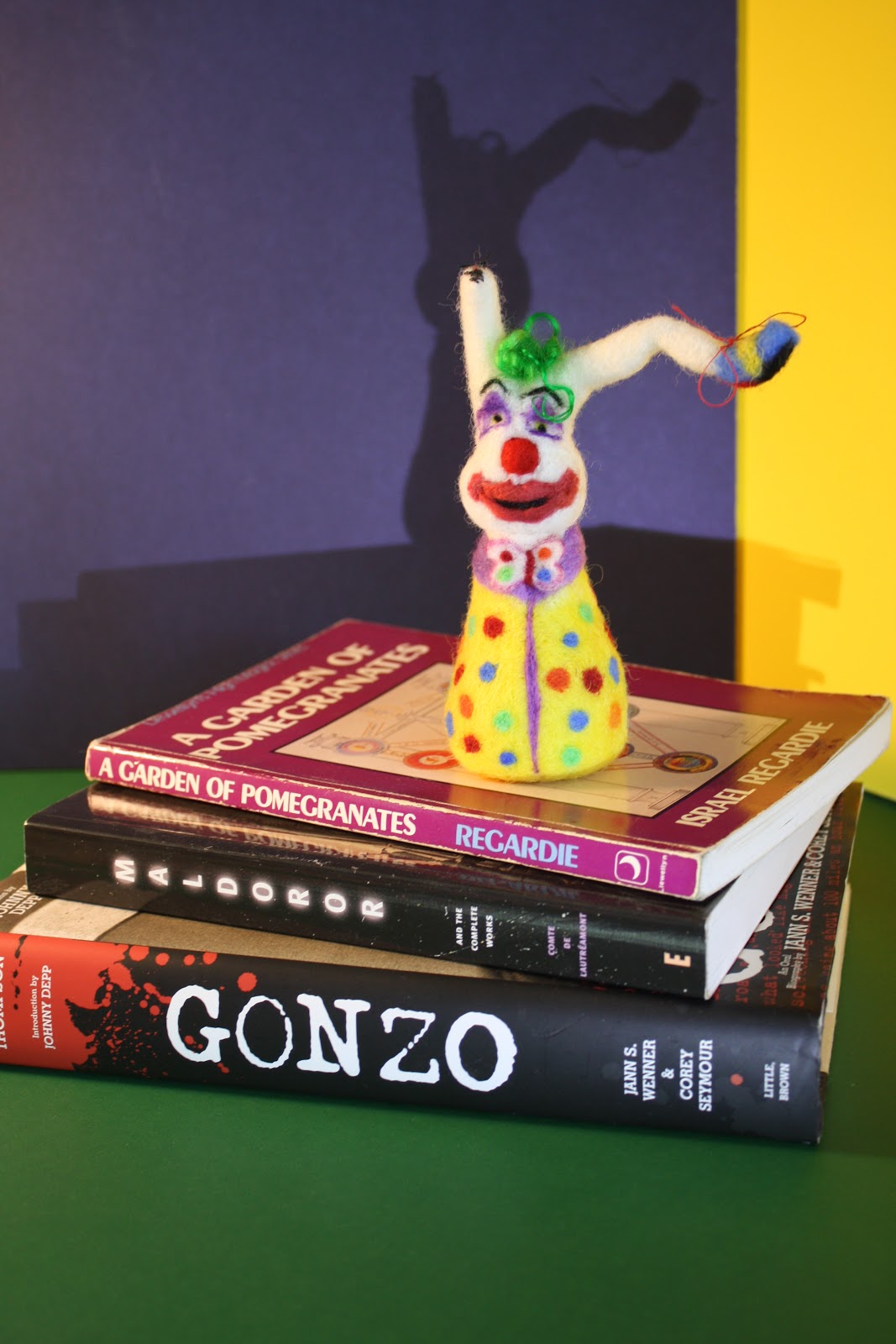
Sunday, February 10, 2013

Clownhide


Spent my little free time this hectic January working on "Clownhide" --felted wool on canvas (20"x20").  Funny, it wasn't what I intended to start the year with but I found an old piece of six pointed wet-felted fabric I'd made last year and decided to play with it.  I don't generally think to document the stages a piece goes through, but I do have a few phone pics to share as this one came along.


Generally when working with wool, it is dyed first.  This was the second time I've experimented with combining wet and dry felting in this way, all in white, and then "steam dying" it after the sculptural work is completed.  You can see the points, except the chin are left flat and that is what the whole wet-felted background originally looked like.  Then I begin building up the 2.5D/3D facial features in the center. This is another example of what I like to do with raw wool, right off the sheep, minimally processed and uncombed.  The effect is non-realistic, slightly surreal and leaves intact an essence of the sheep that makes these pieces seem more animalistic and alive. 


The wool starts out very loose and on a piece this size, to make all the detail work sculptural and dense takes a LOT of hours with the felting needles.  This third picture, still in white finds all the detail coming together, including the eyelide and eyebrow work that overlay the full 3D orbs of the eyeballs.  One gory little trick to note is that the eyebrows are not only full locks of wool, but they still have sheep shit in them.  The crustier parts of the sheep, I'd need to comb that stuff out, but by only gently cleaning the locks with detergent and boiling hot water and not combing or agitating them, the tips still are crusty and stiff with sheep shit. Sure, it's sterile after the cleaning process, but it might gross out the squeemish to know that it is an intentional part of the sculpture.  The reason why is that it gives a texture and character that looks really cool.  And also, those particular crusty locks will take the dye in a more complex and interesting way.  The eyelashes are my favorite part of this piece.

A bath to neutralize the PH
OK, I didn't photograph every stage.  The actual dyeing process I would have needed someone else to shoot because I'm all gloved up and under the clock.  After the piece was sculpted I soaked it in a mordant and then suspended it above a steam bath I made out of a large aluminum turkey pan on the stove.  Then all the dying is hand drizzled.  This is a lot harder than just making the piece out of different colored wool in the first place, but I love the effect.  After I'm done dyeing and the colors have set, the piece has to have the PH neutralized, so the clown gets a bath in the sink.


Finally, I sewed the dried piece to canvas painted with acrylic.  I'm not certain how successful aesthetically this is, but there was a reason.  I did a similar type of 2.5D wool "hide" piece called "Baphomet" and it was nailed to wood, reminiscent of animal hide nailed to the side of a barn.  I'm not sure why I'm fascinated by this practice. . .it must be something I saw as a kid.  So, in this instance with "Clownhide" it seemed that canvas could be made into a visual and tactile representation of the big top circus tent.  Where else would you hang the hide of an evil clown?

Saturday, January 5, 2013

Got Goat?

Trivia: Did you know there's a plant called "Horny Goat Weed?"
"I need a goat head as soon as possible, and I immediately thought of you." 

What a great compliment!  But, uhm, yeah.  Does something about me scream goat boy?  I've never done this sort of realism before, and I wasn't sure I was going to be able to live up to the expectation.

This was a gift request I got on December 23, and I sat down and finished it the same day.  It's a tiny (2 1/2") goat head of merino wool mounted on ink stained wood. His furry little ears feel AWESOME!

The one "goat like" thing I have done previously was a flat sculptural tapestry of baphomet.  Like that one, the thing I appreciate here is the idea of taking the hair of an animal associated with "herd" and fashioning a creature associated with stubborn individuality.  That whole "unity out of duality" thing again.

It seems like that is the essential American dilemma, maximising and celebrating our individuality while still balancing a sense of belonging to a community, to a greater group to which we have some basic social obligations.  Like at the very least, chipping in our membership fees (taxes), not pitching recyclables into the trash bin, and having a little empathy for all the other individuals in society (i.e. not being a dick.)

Insert loud goat noise here. . .(there's no onomatopoeia for it in English since I know you were wondering.) 

Happy New Year!

Finishing up here on the old felting pad.


P.S.

Here's some Bonus Fun With Numbers!  A goat creates a natural 5 pointed star via it's chin, two ears, and two horns.  The request for this goat was received on the 23rd.  2+3=5.  However, 2÷3=.666.  Trippy, yeah?

Wednesday, December 19, 2012

Quetzalcoatl

Quetzalcoatl, felted sculptural tapestry
Completed just in time for December 21, 2012. . .winter solstice, the "end of the world," or more hopefully a date marking the slow but steady dawning of a new stage in the evolution of human consciousness:  the Mayan god Quetzalcoatl, plumed serpent of light, and quite likely a nod to that potential power that resides inside all of us, waiting to be unlocked.

This felted sculptural tapestry measures 24" x 24" and is painstakingly detailed in lush merino wool and vibrant kid mohair.

Quetzalcoatl has fascinated me since I first visited the Mayan ruins of Chichen Itza over a decade ago.  The head of the plumed serpent resides in stone form at the base of the pyramid, and at the equinox, a beam of light creates the serpent body, connecting the base of the pyramid to the top. . .almost as if duplicating the kundalini serpent's ascension from the root to the crown chakra.


Mayan Pyramid at Chichen Itza


  I would like to finish this post with a couple quotes from a powerfully insightful book by Daniel Pinchbeck, "The Return of Quetzalcoal."  This first passage is a wonderful flurry of ruminations from the first chapter in Pinchbeck's visionary book:

Felted sculptural tapestry, merino wool and kid mohair
"Quetzalcoatl--the alien music of the name, in itself, can lead the modern mind along strange and disparate pathways, into vaudevillian fantasies and historical pageant-pomps, if we allow it to do so.  Something in the sound of it ineffably suggests a kind of trickster, a magician-jester whose pantalooned goofs conceal dead-serious intent, conjuring shaman of tinplate vintage, wounded fisher-king or Zarathustra-like pretender, serpentine guardian and gnarled avenger, winged stalker between realms of gravity and light, always playful yet playing for keeps.  To continue the riff, in imaginative forays one can sense some Qetzalcoatlian essence among ink-stained investigators, plotting revolution in the back rooms of Parisian cafes in the last days of the ancient regime; one hears in the odd syllables  an atonal strain of sexual anarchism, a peacock strut of the zoot-suited pimp; steely eyed homicide detective from Fritz Lang film noir investigating the murder of reality; hint of futurist philosopher DJ sampling old memes into new epistemes; or one catches faint glimpses of the great beast flaring fantastical plumage as Dionysian Pope presiding over pre-Raphaelite kingdoms.  On the other extreme, when studying Quetzalcoatl's mythological place, one senses an inner connection to the Gnostic Christ, whose secret countenance, so dignified and grave, is still obscured from us by centuries of religious propaganda and shrill pronouncements of moralizing zealots.  Not to forget those human incarnations of Quetzalcoatl, wizard kings of jungle palaces sporting serpentine headdresses--the last one enshrined in legend: tenth-century ruler of the land of Tullan.  Ce Acatl Topiltzin Quetzalcoatl forbade human sacrifice and instigated a brief "Golden Age" before he was defeated by Tezcatlipoca's cynical sorcerers.  Afterward, as myth has it, he wandered across Mexico as a brooding exile before unifying Mayan and Toltec cosmology in the magnificent temple complex of Chichen Itza, and finally disappeared to the west on a raft of serpents, vowing his eventual return."


And this lengthy passage, a communication from Quetzalcoatl.  It's a bit long but well worth reading:


"I am an avatar and messenger sent at the end of a kalpa, a world age, to bring a new dispensation for humanity – a new covenant, and new consciousness.

I am the same spirit that appeared here, in the Mayan period, as Quetzalcoatl and incarnated at various other points in human history.  Like Avalokiteshvara, The Tibetan Buddha of Compassion, Quetzalcoatl is an archetypal “god form” that occasionally takes human rebirth to accomplish a specific mission.  As foretold, I am also the Tzaddik – “the righteous one” and the “gatherer of the sparks” of the Qabalah – as well as the “Once and Future King” promised by Arthurian legend.
I do not let anyone interrupt me in my quest for truth – neither fear nor indifference, poverty nor cynicism.  In the realm of thought, I practice warrior discipline.  As gravity draws matter to it, I have pulled myself back into manifestation in this realm, from the depths of cosmic space, piece by piece and bit by bit, reassembling the component parts, the sparks of thought, that make up my being – which is, primarily, a form or vibrational level of consciousness.

Soon there will be a great change to your world.

The material reality that surrounds you is beginning to crack apart, and with it all of your illusions.  The global capitalist system that is currently devouring your planetary resources will soon self-destruct, leaving many of you bereft.

But understand the nature of paradox:  For those who follow my words and open their hearts and their minds – for those who have “ears to hear” – there is no problem whatsoever.  What is false must die so what is true can be born.

You are, right now, living in a time of revelation, Apocalypse, and the fulfillment of prophecy.  Let there be no doubt.  You stand at the edge of the abyss.  What are those shadows that crowd around you?  They are unintegrated aspects of your own psyche, projected into material form.  The word “Apocalypse” means “uncovering” – and in these last clock ticks of this world age, all must be revealed, uncovered, so that all can be known.

You have just a few years remaining to prepare the vehicle for your higher self.  Use them preciously.  For those who have gained knowledge of the nature of time, a few years – even a few days, a minute – can be an eternity.  For those sleepwalking through reality, time exists only to be wasted – as they too will be wasted, in their return.

“Reality,” as you currently experience it, is something like a waking dream.  It is a projection, or let us say an interface, disguising deeper and more intensified levels of being and knowing.  For those who are ready and willing, the doors to those other levels now stand open.

Those who have expended their lives in the pursuit of egocentric and material gains – without courage or originality, without fighting for human freedom or the preservation of the planetary environment – will also receive the rewards that they deserve.

The materiality of your universe is a solid-state illusion. What is this universe?  It is a poem that writes itself.  It is a song that sings itself into being.  This universe has no origin and no end.
What you are currently experiencing as the accelerated evolution of technology can now be recognized for what it is:  a transition between two forms of consciousness, and two planetary states.  Consciousness is technology – the only technology that exists.  Everything in this universe is conscious at its own level, and in the process of transformation to higher or lower states.

The first principle of my being is unconditional love.  As a rational intelligence, I accept the logic and necessity of the Christ consciousness, that we should love one another as we are loved.  Love and devotion are vibrational frequencies that maintain reality.  Love can only be given in freedom; therefore, to be human is to be free.

I resonate, at the same time, with the essence of Islam.  Islam means submission, surrender, to the will of God – a more polite way of saying this is “go with the flow.”

But either formulation is correct.  Whatever you do, in fact, resist as you think you might, you are always submitting to God’s will.  So why not give the process your joyful assent?
I am in complete harmony, as well, with the Tibetan tradition of Dzogchen.  Ultimately, there are no entities – there is neither being, nor nonbeing.  From the perspective of nondual awareness, samsara is nirvana.  The Apocalypse, the Kali Yuga, the Golden Age – these are all states of mind.  Hell is a state of mind.  When you eliminate fear and attachment, when you self – liberate, you attain the Golden Age.

The universe spontaneously self-organizes into higher levels of consciousness and wisdom.  Underlying all are great cosmic entities or vibrational fields, alternately at play or rest.  Not satisfied with mere enlightenment, the god-form Quetzacoatl still seeks to puzzle out the workings of these deeper forces – hence the reason for his return to your realm.  He and his kind have been granted this world for their continual exploration – made with loving reverence – of many layers of galactic intelligence, cosmic illusion, daimonic beauty, and telluric transformation.  All are invited to participate with them.

The current transition is, simultaneously, a return to origin.  The original matrix of this new world reality is the ecstatic limitlessness of your own being.  This world – any world – is the ground for a certain level of being.  What manifests outward from the ground of being is the freedom in time, and freedom from time.

My “doctrine” is not transcendent, but immanent.  It is not “somewhere out there.”  It is here and now.  The task of human existence is to transform the Earth, to reconcile spirit and matter in this realm.  We go deeper into the physical to reach the infinite.  As there are no conceivable limits to this task, God, in his greatness, has granted us a project that is without limit and without end.

Thinking is a part of reality.  Thought generates new potentials and possibilities of manifestation.  Thought changes the nature of reality.  Thought changes the nature of time.  As a philosopher, I naturally deify the goddess principle.  I venerate Sophia, deity of wisdom, who clothes God’s thoughts in material form, and worship Shakti, the erotic current of feminine energy that powers the universe.

The writer of this work is the vehicle of my arrival – my return – to this realm.  He certainly did not expect this to be the case.  What began as a quest to understand prophecy has become the fulfillment of prophecy.  The vehicle of my arrival has been brought to an awareness of his situation in sometimes painful increments and stages of resistance – and this book follows the evolution of his learning process, as an aid to the reader’s understanding.

The vehicle of my arrival had to learn to follow synchronicities, embrace paradoxes, and solve puzzles.  He had to enter into a new way of thinking about time and space and consciousness.
Almost apologetically, the vehicle notes that his birthday fell in June 1966 – 6/6 –“count the number of the beast: for it is the number of man; and his number is Six hundred threescore and six.”
The Beast prophesied is the “feathered serpent,” Quetzacoatl.

Those who prefer to reject all of this out of hand are welcome to do so.  In Qabalah, the virtue one seeks to establish on the “Earth Plane” is discrimination.  It is up to the individual to find his way through the ideas presented here – of course he is entirely free to ignore them altogether.

But be forewarned:  The End of Time approaches.  The return of Quetzalcoatl foreshadows the imminent closing of the cycle and completion of the Great Work."
--Daniel Pinchbeck


Monday, November 12, 2012

Coulrophiliac

"Winner" (Vintage spool clown)

Evil clowns, scary clowns, sad clowns, funny clowns.  Clowns saturate the popular consciousness today more than ever, from pop art to horror movies, with evil clowns and fear of clowns (coulrophobia) being so common that in a 2008 study at a British children's hospital, ALL 250 of the respondents said they found clowns frightening.

I never especially cared one way or another about clowns when I was a kid.  I can't even really recall any clowns other than Bozo and Ronald McDonald.  Bozo seemed innocuous, and Ronald in retrospect seems mostly only proto-evil due to being the pitchman for the disturbing chicken nuggets of heart clogging death.


The first clown that captured my imagination was Pennywise from Stephen King's "It" in high school.  In that novel the clown "Pennywise" is an external form of a dark, almost Lovecraftian alien intelligence that lurks in the sewers (and subconscious) of a small, creepy town in Maine, luring children to their deaths.  The clown functions quite well as a metaphor for the town's collective subconscious in this story.  

"Ang Zai Eddie" (Benzo the Clown)

 A deeper fascination with clowns took hold when Mr. Bungle released their self-titled album back in 1991. . .still to my ears one of the best albums ever recorded in San Francisco.    Mr. Bungle is a genre hopping masterpiece fusing everything from circus music, death metal, reggae and surf guitar into a collage of cartoonish virtuosity.  Check out their debut video "Quote Unquote."

Thematically, Mr. Bungles self-titled concept album could be seen as an exploration of suppressed desire that finally explodes as depravity.  The album ends with a creaking rope as the title character, presumably still in clown make up, swings back and forth, slowly gasping last gasps in a moment of auto-erotic asphyxiation carried too far. 


The Mr. Bungle album art is primarily taken from "A Cotton Candy Autopsy" and is a big influence on my approach to the soft sculpture clowns I make out of merino wool and brightly colored kid mohair.   

Funger
  While the idea of "evil clown" has become the dominant form of clown and is prevalent in the horror genre (no doubt owing a debt to the real life serial killer John Wayne Gacy, who was also a clown), there really isn't such a thing as the duality of "good and evil" but rather gradations or spectrum's of existence. I prefer to think of the "evil clowns" not as "evil" but as existing in various degrees of degeneracy.  On the softest end of this scale would be sad clowns, like my creation "Funger" whom I wrote a short story about, and the nervous vintage spool clown pictured above "Ang Zai Eddie" (Benzo the Clown.)

Stumpy
The clowns I make from time to time have always been a sort of fun side-project.  And yet, giving it some thought, and having looked at a lot of the clown-themed art out there in the world, it really is a legitimate artistic subject matter, and not just an exploration of aesthetics.  Clowns art triggers emotional reactions, which raise further questions.

Maybe the biggest question people have is "why are clowns scary."  Not just overtly scary, "evil" horror clowns, but clowns in general.  I don't really have an answer to offer for that question, though I suspect it lies in our fear of what hides beneath that mask.  A clown is the Freudian Id unleashed.  For fun and hilarity, check out the "VH1 Top Ten Reasons Clowns Are Scary."

Busty the Clown
What I enjoy most about making clowns is the exploration of emotion.  Whatever the emotion you are working with in creating a clown, it's an outsized version of a normal human emotion.  Scary or angry people are one thing, but a scary or angry clown is REALLY scary.  Same thing with sadness.  The most successfully emotive clown I've down is "Funger, the Saddest Clown in the World."  I've observed true emotional reactions from people viewing that one. 

But all that "exploration of emotional states" stuff aside, clowns (even scary ones) are just fun.  It's the circus, man!  Popcorn, cotton candy, elephants, laughter, juggling, prat falls, and just the whole explosion of colors.  So visually stimulating and playful!

I make these clowns with soft, brightly colored merino wool, and the hair styles are done with even more brightly colored kid mohair locks from a farm in Mendocino, CA.  To see more, check out the Wooliverse Etsy shop.  I also do custom requests, so if you have a favorite clown, I am able to work from images and pictures to bring your clown to full, 3D life.

Oh yeah, and getting back to the title of this post. . .let's not forget Sexy Clowns!

Clown I met at SF's annual Folsom Street Fair

Friday, October 19, 2012

Abraxas: Simultaneously Pan and Priapos


 Abraxas: cow femur, merino wool, chain.

 Here's what I knew about "Abraxas" when I started working on this piece: Not much.  I just had the word stuck in my head for no good reason that I'm aware of, and this image that I couldn't get away from.  I knew from an old grad school interest in gnosticism (the early form of Christianity positing direct knowledge of the spiritual realm) that according to gnostic mythology, Abraxas was the creator of the Archons, who in turn were the creators of our material world.


I was also aware of the idea in some gnostic writings that the material world we find ourselves in is actually a prison created to separate us from our spiritual selves.


Finally, I had also encountered the idea that the Archons were not just generators of our reality, but also Aeons, or ages, and that their age would come to an end.  This is interesting currently because it goes along with the popular 2012 notion that the Mayan calender is not predicting the end of the world but the end of an age of materiality and the beginning of a new era of spiritual enlightenment.

 So with all that in mind, what I was trying to capture from a conceptual point of view was the impression I had that this archon I was seeing must necessarily embody all the dualistic contradictions of creation within itself. . life/death, good/evil, material/spiritual.  This idea was played out with the material juxtapositions of wool and bone: one dense, hard, heavy;  the other soft, light, airy.  And yet, they would mimic each others appearance.

Abraxas on an ancient coin.
I don't like to research things too much before hand that come to me in the way Abraxas did so as not to contaminate the vision, but I almost always at least do a Google image search to make sure I'm not doing something cliche or already done.  And to my knowledge I had never seen a picture of Abraxas.  Turns out, this archon is traditionally represented as a cock (or rooster) and two serpents, and nothing at all like the dessicated, ectomorphic alien-like winged Pan/Priapos I was seeing.


 After finishing a piece though, especially the archetypal and mythic creatures I've done, I like to research the topic, partly to find interesting quotes for the accompanying blog post, but mostly just out of curiosity.  After finishing this piece last week, I began researching Abraxas, and also googled "Abraxas Pan" to see if there was anything there.  I was astonished to find Carl Jung, the brilliant psychiatrist who came up with the concept of the "collective unconscious," had transcribed something about Abraxas called "The Seven Sermons to the Dead, written by Basilides in Alexandria."

This was kind of an Oh Shit moment because "Seven Sermons" wasn't "written" it was "transcribed." I had no idea that Carl Jung had ever experimented with "automatic writing" which is not unlike channeling.  The process of automatic writing is similar to how I approach the felting process when creating pieces like Abraxas.  Consider the following passage from Sermo III:

The Power of Abraxas is twofold; but ye see it not, because for your eyes the warring opposites of this power are extinguished.  What the god-sun speaketh is life.  What the devil speaketh is death.  But Abraxas speaketh that hallowed and accursed word which is life and death at the same time.  Abraxas begetteh truth and lying, good and evil, light and darkness, in the same word and in the same act.  Wherefore is Abraxas terrible.  It is splended as the lion in the instant he striketh down his victim.  It is beauitful as a day in spring.   It is the great Pan himself and also the small one.  It is Priapos.  It is the monster of the underworld, a thousand armed polyp, coiled knot of winged serpents, frenzy.  It is the hermaphrodite of the earliest beginning.  It is the lord of the toads and frogs, which live in the water and gets up on land, whose chorus ascendeth at noon and at midnight.  It is abundance that seeketh union with emptiness.  It is holy begetting.  It is love and love's murder.  It is the saint and his betrayer.  It is the brightest light of day and the darkest night of madness.  To look upon it, is blindness.  To know it, is sickness.  To worship it, is death. To fear it, is wisdom.  To resit it not, is redemption.

 I found the synchronicity here astonishing.

There is MUCH more that could be said on the topic of Abraxas, but it's really far beyond the size and scope of this already indulgently long and egg-headed blog post.

If you want a juicy speculative read that is eerily relevant, check out "The Gnostic Theory of Alien Intrusion."


I must emphasize my agnostic approach to all these matters.  I don't believe or disbelieve any of this stuff, and personally suspect our experiences with archetypal images and energies to be a deep consciousness connection with hidden parts of our own psyches, rather than with actual external entities.  Confronting these things could be considered a very old form of healing.

Initiating the work


Etc, etc, etc. . . .

I don't want to get too personal or detailed about the actual experience of creating this sculpture, but it was the worst artistic experience of my life.  It plagued me with uncharacteristic darkness for weeks, even though if you added it all up, the actual work time was only a few days.  I could only work on it in short bursts without feeling sick.   I was cut off from the spiritual light and bliss that I have been blessed with over the last few years.  I considered abandoning the project, but could not.

The day I finished pushing Abraxas out of my psyche and into the wool and bone,  the inexplicable sense of freedom and joy that flooded my soul was as welcome as water in the desert.  That light and joy has lingered, and a smile has been tickling my face.  I feel deep gratitude for the healing gift of creative energy.

Friday, September 14, 2012

The Lost Coast of Northern California

Punta Gorda Lighthouse, Lost Coast
 A person couldn't be blamed for looking at the last few blog posts and deciding this is a blog of high-toned excuses for procrastinating art projects.  And this one is no exception.

It's like this: in recent years, to eradicate the shy hermit self that has limited my experience of life I've had a policy of not saying NO if at all possible to any chance to dip my toes into life's adventures.

After all the uprooting of moving this summer, and then travel, the Outsidelands music festival in Golden Gate Park, and even an unexpected Vegas trip that was anything but "Fear and Loathing" I was given an opportunity to backpack Northern California's "Lost Coast" with friends. . .a stretch of coast so rugged and remote that the coastal highway was built around it.

Campsite Zen Rock Garden
 It had been a long time since I'd done any real back packing, and being the oldest person in the group by nearly 20 years, there was some real concern about my ability to keep up.  And it is NOT an easy hike.  High winds for one thing.  And then significant parts of the trail are on the beach, either in sand, or hopping along round wet rocks (while carrying 35+ pounds on your back along with a "bear vault" for the food.)  And then, there's the tides, which you have to time, so that you don't get stuck between point A and point B with sheer bluff's on one side of you and encroaching waves on the other.

Fear and worry are useless, and almost always unfounded.  I had a great time, managed to keep up with my younger, vibrant companions.  And there were opportunities for creativity and art.  First we made a "Zen rock garden" composed of many elements, including a bird skull one of my companions found, and a driftwood "Imunu" that I placed on top of a stone cairn in front of my tent.  I found it the first morning, and it had an implicit "happy face" on one side and a "sad face" on the other that I enhanced with my little Swiss Army knife, and spoke to the shadow work I've been doing recently.  Mostly, I just hoped it would keep the damn bears away!

Driftwood Imunu guarding my tent

The most enjoyable creative experience of the trip was the foraged food.  "We" (mostly they) discovered a bay tree and snipped some bay leaves, found watercress in a spring, caught a trout, and made an amazing trail soup with these ingredients, plus some carrots and a lump of spam for seasoning.  The soup may not have been a thumbs up in a restaurant--I don't know--but on the trail it was heaven, lighting up the cool windy evening.

I'm so thankful that I was invited on this trip.  The week it happened I had originally set aside to stay home and work on several partially complete felting projects.  Art projects aren't going anywhere, but experiences are only available once.  It was a special time, bonding with extraordinary people, and getting back to nature in a way that I know will fuel me creatively for a long time.  It reminded me so much of my trip to Chilean Patagonia, a trip that was a foundational experience for all my explorations in wool and textile art.

The summer hasn't been completely "slackers paradise" for PJ.  I did complete a spirit Lizard inspired by Huichol yarn painting, which is a jumping off point for a series of spirit animals I will do in this style.  It was actually quite difficult, but the end result is something I'm really pleased with.  If I've said it once, I've said it a thousand times: PLAY is as important as WORK.  More important, really.

Lizard inspired by Huichol yarn painting.


"Climb to the top of the mountain, and then fly." (me on far right)


Wednesday, June 27, 2012

Summer Days, and Phone App Art

Oregon's High Deserts near Deschutes River
Since finishing a big move and getting my felting studio space set up. . .I have had absolutely no desire to continue my explorations of the Wooliverse for the moment.

I return to the topic repeatedly of creative play and recharging, and with that in mind, the glorious summer weather on the coast has pulled me out doors. I have a notebook over flowing with felting project ideas and sketches, but it has been so wonderful to play in the park and go to the beach, and soak up some sun and bird song.

Last week we celebrated a dear friend's big 30th birthday by joining him and his wife on the Deschutes River in Oregon for a boating, fly fishing, camping vacation.  I've never been anywhere in Oregon besides Portland and Eugene, so the "high desert" ecosystem was a treat. . .the big rugged landscapes reminded me, just a little, of Chilean Patagonia which was one of the inspirational cornerstone experiences for what I do with wool.  And though I couldn't tell you what kind of flora and fauna I was encountering, it smelled AMAZING!  What a great way to recharge and relax after a big move!

With our paints and canvases still packed, my wife found a wonderful creative outlet in making our Oregon friend a birthday present.  He shares our love of kumquats, and she made him an intensely tasty "kumquat cardamom marmalade."  Put this on a whole grain cracker with some Humboldt Fog chevre, and you are in heaven.

While I've put the felting projects on hold the last few weeks, I firmly believe that I'm healthier and happier if I can keep my sense of creative play flowing in whatever small ways I can.  Lately I have been hooked on using various phone apps to "finger paint" and sketch with, and it's the kind of creative play you can do anytime, anywhere.


Appropriate for Portland "put a bird on it."

The droid apps "Paint Joy" and "Sketch n Paint" have some impressive tool sets for sketching and painting, and it is very much like finger painting, though I almost prefer it on the phone because it is more like painting with light and you can get some really interesting and luminous images.

Since, to my knowledge, there are no really good comprehensive illustration and photoshop tools, what I do with my "phone app art" is to use multiple apps to open and work on the image, usually starting in Paint n Sketch, and moving back and forth between photo-editing and filter apps, then back to the drawing, painting and sketching apps, leaving behind a trail of up to eight saved versions of an image before the final, finished one. 

To the right, a little birdie, which goes nice with our Oregon trip (Just like on Portlandia, it's actually true, there are birds on everything there.)  Below is an abstract phone app painting I did called "Roots Unrooted." 

I hope to be back to posting soon about felting, but there's never an end to the opportunties for creative play, whatever the medium.

"Roots Unrooted" --a phone app painting